Date of publication:
01/07/2026
Bangladesh
Do domestic laws and policies provide for the issuance, replacement and renewal of official personal identification documents for forcibly displaced and stateless persons?
Assessment by population
Analysis
Bangladesh is not party to the 1951 Convention and its 1967 Protocol. Bangladesh does not have any statutory law relating to issuance of identity documents to refugees including for those who do not possess travel documents.
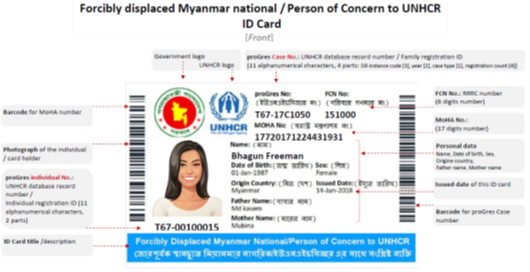
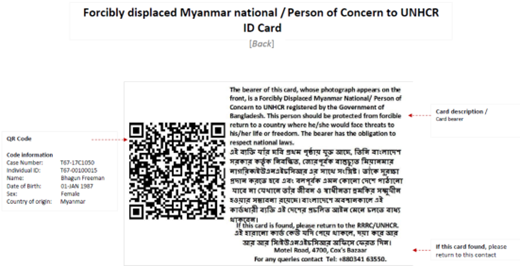
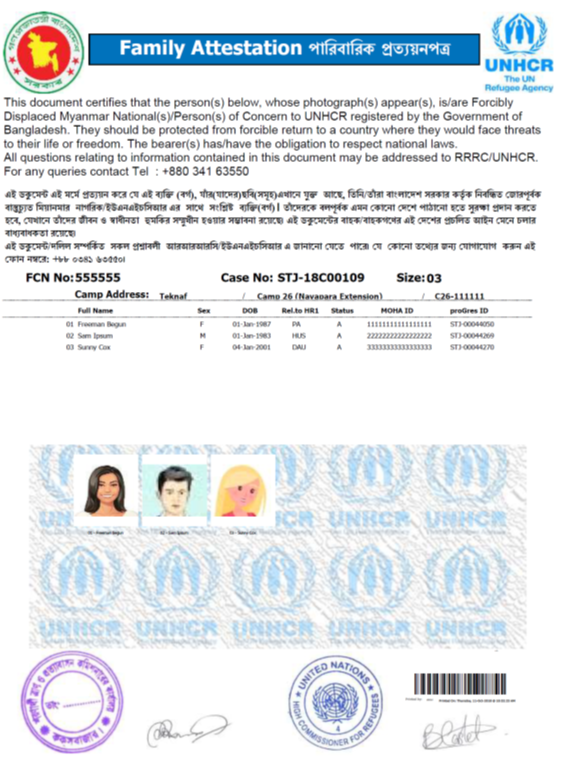
The Foreigners Act of 1946 regulating entry, residence and departure of foreigners, generally applies to refugees. Rohingyas who arrived in the 1990s were jointly registered by the Government of Bangladesh and UNHCR and received documentation (Master Registration Card; MRC). The Rohingyas who arrived in Bangladesh in subsequent influxes were not registered by the Government until the latest influx of August 2017. Those previously unregistered and those who arrived in the influx of August 2017 were registered, in a Joint Registration exercise under the provisions of the 2018 UNHCR-Government Memorandum of Understanding (MoU) on the Exchange of Personal Data of Forcibly Displaced Myanmar Nationals/Refugees. The Government identifies this group as Forcibly Displaced Myanmar Nationals (FDMN) while UNHCR identifies them as refugees. The refugee ID cards issued to this population bear the official logo of the Government and UNHCR. While legal status of refugees is not recognized in Bangladesh, these ID cards are accepted as documentary proof of their identity to access protection services and humanitarian aid in refugee camps in Bangladesh.
In addition to Rohingya refugees, Bangladesh hosts a small number of non-Rohingya refugees and asylum-seekers who predominantly live in urban areas. In absence of national asylum legislation and asylum mechanism, UNHCR registers these individuals and conducts Refugees Status Determination (RSD) under its mandate. The Government does not register non-Rohingya asylum-seekers and refugees in Bangladesh. Those registered with UNHCR are issued an individual asylum-certificate, and upon recognition, receive refugee ID cards. While the UNHCR issued documents do not entail any legal status for these asylum-seekers and refugees in Bangladesh, they may provide a degree of protection, particularly from arbitrary arrest and refoulement.